


Why your magnetic solution is now a strategic decision.
Magnet imports under pressure: risks for your procurement
Why magnetic solutions today determine your planning reliability
Magnets are inconspicuous at first glance. In practice, however, they often decide whether a product works, is delivered on time - or causes problems.
Neodymium-iron-boron magnets (NdFeB) are a key component of high-quality packaging, folders and advertising materials in particular. They enable secure, invisible and resealable closures.
But their use goes far beyond this.
Magnets are used wherever components need to be precisely positioned, temporarily fixed or flexibly connected. This includes displays and POS systems, technical assemblies, covers, flaps or modular constructions. They are also used in exhibition stand construction, shop fitting and medical technology - wherever quick assembly, removability and a clean appearance are required.
This versatility makes them so valuable - and at the same time so critical.
Because it is precisely these seemingly small components that are currently becoming a decisive factor in procurement.
Their availability is no longer a matter of course.
Why magnets are more than just a component
In many applications, magnets are taken for granted. They work in the background, are easy to integrate and are barely noticeable in everyday life.
This is precisely the problem.
This is because magnets are often only noticed when they are missing or do not work as expected.
The effects affect not just a single component, but your entire production. If magnets are not available or quality deviations occur, processes come to a standstill.
A missing or unsuitable magnet can be enough to delay or stop an entire series. This results in reworking, time pressure and, in the worst case, missed delivery deadlines.
Why magnet supply is currently under pressure
The current market situation is characterised by increasing demand for high-performance magnets and, at the same time, structural dependencies in the supply chain.
China dominates the processing of rare earths and the production of rare earth magnets. As a result, political decisions and regulatory changes have a direct impact on global availability.
In practice, this is reflected in several factors simultaneously:
- Prices are subject to greater fluctuations than in the past
- Delivery times are lengthening or becoming less reliable
- The coordination and documentation effort in procurement is increasing
This development not only affects large corporations, but increasingly also medium-sized companies.
Additional uncertainty: global crises have an indirect impact
In addition to structural dependencies, geopolitical developments are also causing additional uncertainty in supply chains.
The current Middle East crisis has no direct impact on the availability of neodymium magnets. The underlying raw materials come mainly from China and are not directly affected by this conflict.
Indirectly, however, new risks are emerging.
Disruptions in key trade routes, rising energy prices and higher transport costs are impacting global supply chains. Shipping bottlenecks and fluctuating freight costs in particular can lead to longer delivery times and more uncertain planning.
In addition, rising prices for energy and metals are increasing production costs in many industrial sectors - including where components for magnet applications are further processed.
The result is an additional burden on already strained supply chains.
Supply remains stable in the short term. But as escalation increases, so does the risk of delays and cost increases - even for products that are not directly affected.
This shows that supply chain risks today arise not only where production takes place - but also where transport takes place.
"
Export controls: More complexity in the supply chain
Since 2025, China has further specified and expanded its export controls for rare earths. Even small amounts of critical materials can trigger an authorisation requirement for certain products.
This means that supply chains are becoming more complex.
Manufacturers and retailers must document more precisely where materials come from and how they were processed. At the same time, additional testing processes can lead to delays.
What used to be a straightforward procurement process now requires significantly more attention and coordination.
The direct consequences for your production
Many companies today work with tightly synchronised processes and low stock levels. This increases efficiency, but at the same time reduces buffers
.
If a component is delayed, this immediately affects the entire production process.
Typical consequences are postponed delivery dates, additional coordination efforts and increasing time pressure. In some cases, you have to improvise in order to complete projects on time.
This situation is not only operationally challenging, but also puts a strain on the relationship with your customers.
The worst case: When a magnet is missing
As small as a magnet is, its importance often only becomes apparent when it is not available.
If a single component is missing, this can mean that an entire order cannot be delivered. The risk is particularly high for products where the function depends on this connection.
The consequences range from production stoppages and contractual penalties to long-term damage to the company's image.
This moment shows how important a stable and forward-looking supply chain is.
What this means for your procurement
The role of magnets has changed.
What used to be regarded as a simple purchased part is now a relevant factor for planning security and risk management.
For procurement, this means that decisions need to be made more consciously. It's no longer just about price, but about availability, quality and reliability.
Companies that take this development into account at an early stage gain a clear advantage.
Quality only becomes apparent in use
With magnetic solutions in particular, the actual quality often only becomes apparent in everyday use.
Differences in material, processing or coating can lead to the adhesive force decreasing or the function not being permanently guaranteed.
The consequences are complaints, reworking and, in the worst case, dissatisfied customers.
It is therefore crucial to rely on solutions that not only impress in the data sheet, but also function reliably in the long term.
Precision from demanding applications
In areas such as medical technology, the demands on connection solutions are particularly high. Materials must be precisely defined, processes traceable and results reproducible.
We also transfer this way of thinking to other applications.
This means that we not only focus on the product, but also on your specific application. This results in solutions that not only work technically, but also prove themselves in everyday use.
How FIXUM supports you
To meet these challenges, you need more than just a supplier. You need a partner who understands market developments and actively thinks along with you.
At FIXUM, we rely on a combination of forward-looking planning, close supplier management and application-specific advice.
We monitor market movements at an early stage and adapt our warehouse strategy accordingly. At the same time, we ensure transparency in procurement and provide support with the necessary documentation.
Our focus is not on standard solutions, but on solutions that work reliably in your specific application.
Our goal is clear: to keep your processes stable and mitigate risks as early as possible.
Strategic relevance for your day-to-day work
Current developments clearly show that the framework conditions have changed.
Companies need to take a more conscious look at their supply chains and recognise risks at an early stage.
This includes examining alternatives, managing stocks in a targeted manner and working with partners who offer transparency and reliability.
Those who actively address these issues create security and remain capable of acting.
Working together to find a secure solution
Today, choosing the right magnetic solution is more than just a technical decision. It is a crucial building block for your planning security.
That's why it pays to scrutinise existing solutions and optimise them in a targeted manner.
We support you in finding the right solution for your application and setting up your processes for long-term stability.
Your next step
Would you like to know which magnetic solutions are currently available and how you can better secure your projects?
Then talk to us. We can advise you before supply bottlenecks become a problem.
FIXUM - connecting materials.
More than just products: Discover the solutions for your challenges
Related products

Content: 100 Stück (€0.18* / 1 Stück)

Content: 100 Stück (€0.08* / 1 Stück)

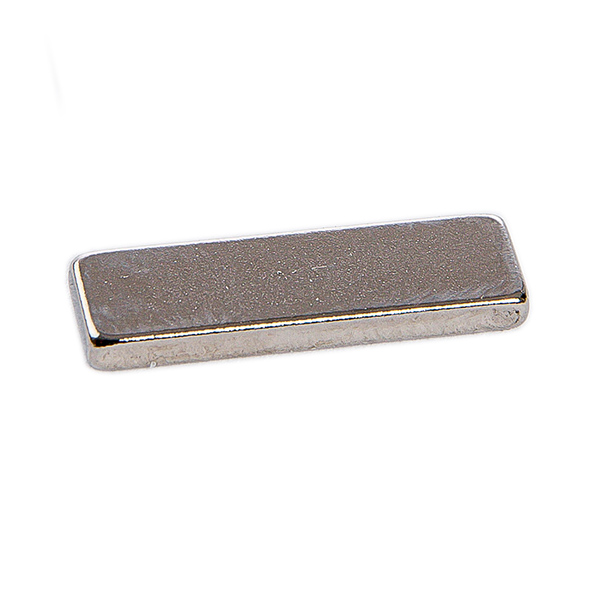
Content: 100 Stück (€0.24* / 1 Stück)
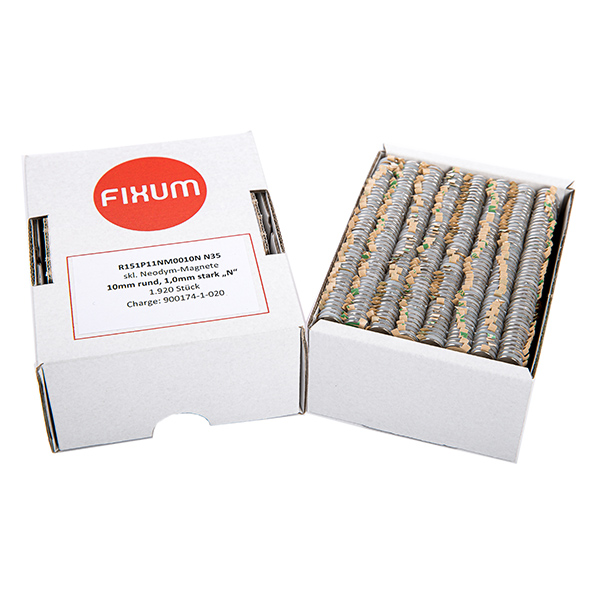
Content: 100 Stück (€0.11* / 1 Stück)


Content: 100 Stück (€0.21* / 1 Stück)