
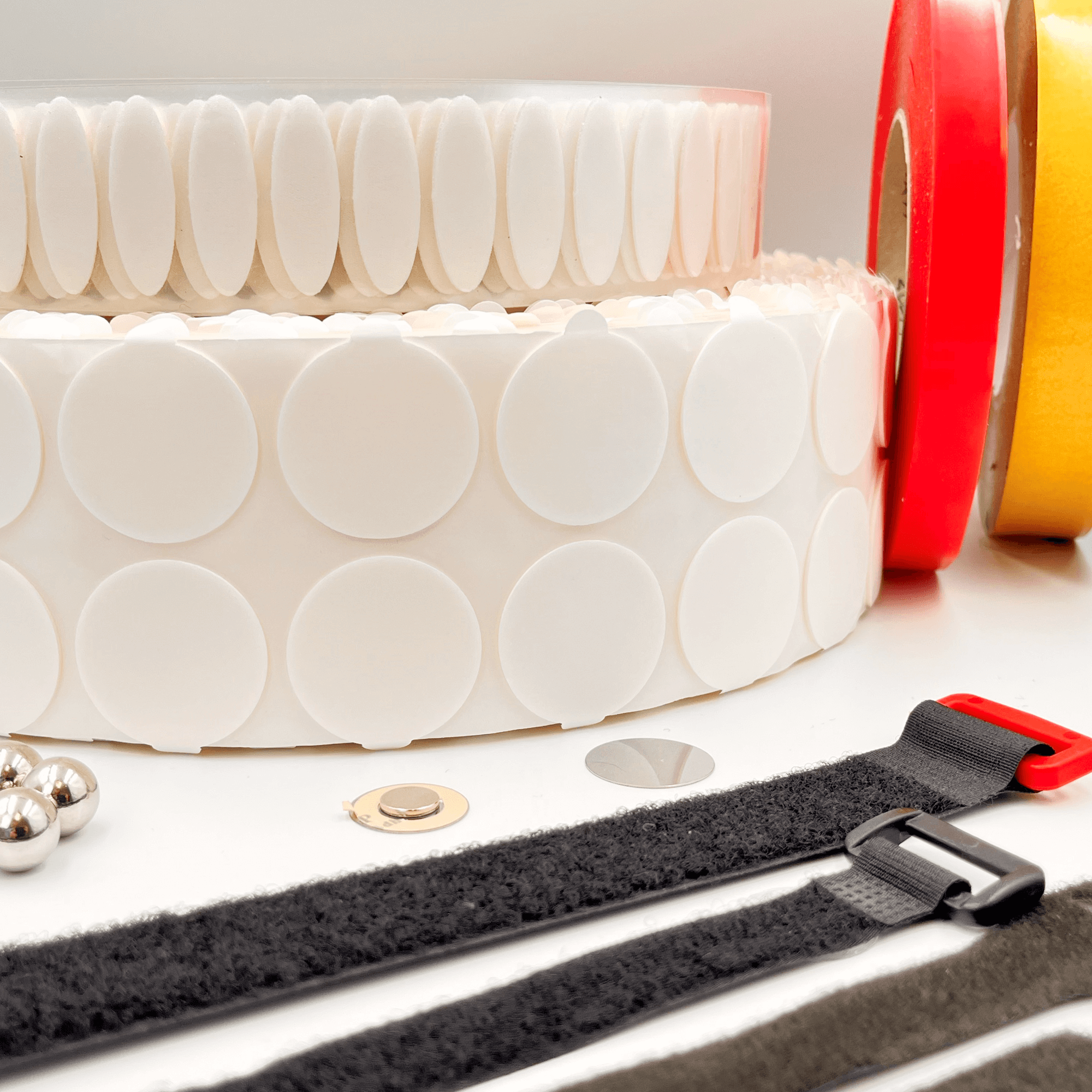

Which mounting tape is best suited to which application? We explain the differences between foam adhesive tape and transparent acrylic adhesive tape.
Foam tape or acrylic adhesive tape
Whether in shopfitting, signage or industrial assembly work: double-sided mounting tapes enable permanent bonds without the need for drilling or screwing. But which adhesive tape is suitable for which application? We’ll show you the differences between foam adhesive tape and transparent acrylic adhesive tape, and explain what to look for when making your choice.
The requirements for an adhesive bond can vary greatly. Whilst the fitting of mirrors or signs calls for high load-bearing capacity and the ability to compensate for minor unevenness, with transparent materials the focus is often on the visual appearance.
Choosing the right mounting tape therefore does not depend solely on its adhesive strength. The nature of the surface, the weight of the components to be fixed, the environmental conditions and the desired appearance also play a crucial role.
In short: choose foam adhesive tape for shock-absorbing joints and to compensate for minor unevenness. Choose transparent acrylic adhesive tape for glass, acrylic glass and visible bonded surfaces where a virtually crystal-clear appearance is important. In both cases, the surface, load and environmental conditions must be suitable for the application.
It is important to note that both mounting tapes presented here are based on acrylic adhesives. The main difference lies in their construction: whilst the foam adhesive tape has a PE foam backing, the transparent acrylic adhesive tape is based on a highly transparent acrylic structure. This results in different properties and preferred areas of application.
Foam adhesive tape: Reliable fastening with shock-absorbing properties
Double-sided foam adhesive tapes consist of a foam backing coated with adhesive on both sides. The foam provides a degree of flexibility and can compensate for minor unevenness and thickness tolerances in the materials to be joined.
One example is the white premium mirror adhesive tape FIXUM 241P10A. It features a PE foam backing with a density of 100 kg/m³ and a high-performance solvent-based pure acrylate adhesive.
This construction makes it suitable for permanent bonding to glass, metal, suitable wooden surfaces and high-energy plastics.
Typical areas of application
- Mirror fitting: Fixing suitable mirrors to load-bearing surfaces.
- Advertising technology: Installation of signs, panels and advertising elements.
- Shopfitting and display construction: Fixing of mouldings, displays and other structural elements.
- Industrial applications: Joining rigid components where minor irregularities need to be levelled out.
The foam backing also acts as a damping layer and can absorb vibrations. This is particularly advantageous in applications where the joined materials are exposed to slight movements or vibrations.
The FIXUM Premium mirror adhesive tape also offers excellent resistance to ageing, weathering and UV radiation. This makes it suitable for both indoor and, where appropriate, outdoor applications.
Product benefits at a glance: High adhesive strength, ability to compensate for minor unevenness, shock-absorbing properties and good resistance to weathering.
Discover the premium FIXUM 241P10A mirror adhesive tape in our shop
Transparent acrylic adhesive tape: Strong bond with a virtually invisible finish
If the adhesive bond needs to be as inconspicuous as possible, transparent acrylic adhesive tapes offer an interesting alternative.
Unlike traditional foam adhesive tape, the FIXUM 201P10A does not have a separate PE foam backing. The 1 mm-thick mounting tape consists of a highly transparent acrylic compound, which ensures both high adhesive strength and a certain degree of elasticity.
Its almost crystal-clear appearance makes it particularly suitable for applications where the adhesive bond would be visible through transparent materials.
Typical areas of application
- Glass and acrylic: Combining transparent materials, for example in display design or shopfitting.
- Shop window displays: Fixing advertising elements where the aim is to achieve the most discreet connection possible.
- Advertising technology: Installation of signs, panels and other advertising elements.
- Shopfitting: Permanent bonding of rigid components and transparent structural elements.
The transparent acrylic adhesive tape also offers interesting advantages in terms of its technical properties. It is characterised by very high adhesive strength as well as excellent resistance to ageing, weathering and UV radiation.
Thanks to its elasticity, it can also compensate for minor thickness tolerances and act as a shock absorber.
Another advantage is that, under the right conditions, the tape can be peeled away from solid surfaces by stretching it. However, whether this can be done without leaving any residue or causing damage depends on the specific surface and the conditions of use.
Product benefits at a glance: Virtually crystal-clear appearance, very high adhesive strength, good resistance to UV radiation and weathering, and elastic properties.
Discover FIXUM 201P10A acrylic adhesive tape in our shop
Foam adhesive tape or acrylic adhesive tape: a direct comparison of the differences
Both types of assembly tape are suitable for demanding and permanent bonds. Nevertheless, they differ in their construction and their preferred areas of application.
| Property | White foam adhesive tape 241P10A | Transparent acrylic adhesive tape 201P10A |
|---|---|---|
| Composition | PE foam with acrylic adhesive | Highly transparent acrylate compound |
| Colour | White | Virtually crystal-clear |
| Thickness | Approx. 0.95 mm | 1 mm |
| Compensation for unevenness | Yes, to a limited extent | Yes, to a limited extent |
| Damping effect | Yes | Yes |
| Weather resistance | Very good | Very good |
| Typical applications | Mirrors, signs, panels, displays | Glass, acrylic, transparent displays, signs |
The information relates to the two FIXUM products presented here: 241P10A and 201P10A. The properties of other mounting tapes may vary depending on the specific version.
Adhesive strength is therefore not the only decisive factor. If a white, cushioning adhesive bond is required, foam adhesive tape may be the right solution. If the bond needs to be as inconspicuous as possible when used with transparent materials, transparent acrylic adhesive tape offers advantages.
For both variants, the substrate, load and environmental conditions must be taken into account.
What is important when selecting an assembly tape?
To ensure that an adhesive bond functions reliably in the long term, a number of important questions should be clarified before application.
Which materials are to be bonded together?
Not every adhesive adheres equally well to every surface. Glass, metal and certain plastics often provide good conditions for bonding. With other materials, such as polyethylene (PE) or polypropylene (PP), selecting the right adhesive tape can be more challenging.
Coated, painted or textured surfaces can also affect adhesion. Particular attention is required with powder-coated surfaces: it is not the underlying metal but the coating itself that is decisive for bonding. Depending on its composition, additives and surface texture, a powder coating may be more difficult to bond to. It is therefore always advisable to check which adhesive tape is suitable for the specific surface.
Is it worth comparing with alternatives?
In the advertising industry in particular, established mounting tapes are frequently used, with different product variants available depending on the surface. These solutions are tried and tested. Nevertheless, it is worth considering technically suitable alternatives as well.
It is not just the brand name that matters, but whether the adhesive tape meets the requirements of the specific application. Factors such as the materials to be bonded, the surface condition, the load, and the effects of temperature, weather and UV radiation all play a role.
At FIXUM, we therefore consider not just the adhesive tape, but the entire application: Which materials are to be bonded? What stresses will be encountered? Will the component be used indoors or outdoors? On this basis, suitable products can be selected and, where necessary, adhesion tests carried out.
In this way, a technically suitable and, at the same time, economically viable alternative can be found.
What load must the joint withstand?
The weight of a component alone is not sufficient to determine the required bonding area. Equally important are the direction of the load, the available bonding area and any potential dynamic loads.
For the white premium mirror adhesive tape FIXUM 241P10A, a minimum bonding area of 70 cm² per kilogramme of weight is provided as a product-specific guideline. The joint should not be subjected to load until 24 hours have elapsed.
However, this information is no substitute for testing the actual application. In particular, for heavy, safety-critical or permanently overhead-mounted components, the suitability of the entire structure must be assessed separately.
What are the ambient conditions?
Temperature, humidity, UV radiation and weather conditions can affect the performance of an adhesive bond.
For outdoor use, it is therefore important to check whether the chosen mounting tape is suitable for the specific conditions.
Both FIXUM products presented here offer high resistance to ageing, weathering and UV radiation, and are therefore generally suitable for appropriate outdoor applications.
Practical tips: How to achieve a reliable bond
Even a high-quality mounting tape can only perform to its full potential if it is applied correctly.
You should therefore bear the following points in mind:
- Preparing surfaces: The surfaces to be bonded must be clean, dry and free from dust, oil or grease. Use a cleaning agent suitable for the substrate.
- Observe the application temperature: For both mounting tapes described, FIXUM recommends an application temperature between 18 °C and 35 °C.
- Press down firmly: Applying even pressure ensures that the adhesive tape makes contact with as much of the surface as possible.
- Do not apply load too soon: Observe the product-specific guidelines regarding the development of adhesive strength and the permissible load.
- Carry out adhesion tests: Before using the product in series production, check whether the mounting tape achieves the required adhesion on the intended materials.
Specific application instructions and technical specifications can be found on the relevant product pages.
Conclusion: The right assembly tape depends on the application
Both foam adhesive tapes and transparent acrylic adhesive tapes offer a wide range of options for permanent bonds in commercial and industrial applications.
The white premium mirror adhesive tape is particularly suitable for traditional assembly tasks where a shock-absorbing bond and the ability to compensate for minor surface irregularities are required.
The transparent acrylic adhesive tape is particularly suitable when, in addition to high adhesive strength, a discreet appearance is required.
Which assembly tape is suitable for your project ultimately depends on the combination of materials, the loads involved and the operating conditions.


More than just products: Discover the solutions for your challenges
Related products


